I develop data-efficient, multimodal methods for post-flood building
damage assessment, integrating remote sensing, computer vision,
social-media imagery, segmentation models, and language models.
Selected publications
2025
Yu, J., Fukuda, T., & Yabuki, N.
“Benchmarking attention mechanisms and consistency
regularization semi-supervised learning for post-flood building
damage assessment.”
International Journal of Disaster Risk Reduction, 128,
Article 105664.
DOI ↗
2024
Yu, J., Fukuda, T., & Yabuki, N.
“Combining social media images and bitemporal satellite
images for automated detection of damaged areas after flooding.”
CAADRIA 2024 Proceedings, vol. 2, pp. 59–68.
DOI ↗
Research projects
Jan 2025 — PresentIndependent research
Multimodal framework for post-flood building damage assessment
Objective
Develop a multimodal deep-learning framework that improves
post-flood building damage assessment by combining visual
evidence with disaster-domain contextual knowledge.
Background
Segmentation models can be limited by ambiguous damage
appearance and scarce labeled data. Large language models
offer complementary contextual priors.
Method
Fine-tuned Qwen2.5-7B on a disaster-specific dataset,
integrated it as a text-understanding branch with a
segmentation model, and fused textual priors with visual
features.
Responsibilities
Developed and implemented the experimental workflow.
Fine-tuned Qwen2.5-7B.
Implemented multimodal fusion and conducted evaluation.
Achievements
VLM adaptation: fine-tuned the Qwen2.5-7B
text branch within LLaVA to generate structured damage
descriptions for three of four damage categories.
Multimodal fusion: achieved F1 0.9456 and
recall 0.9637 for binary damaged classification, exceeding
ChangeMamba by 18.48% and 23.27%, respectively.
Major-damage sub-task: achieved recall
0.9223, a 22.13% improvement over ChangeMamba.
Dec 2023 — Oct 2024Master’s thesis
Benchmarking attention mechanisms and consistency regularization
for post-flood building damage assessment
Advisor: Tomohiro Fukuda
Objective
Evaluate attention mechanisms and image-level consistency
regularization for post-flood building damage assessment, and
develop a semi-supervised approach that reduces reliance on
large labeled datasets.
Background
Post-flood damage assessment requires timely, reliable
building-level labels; however, pixel-level annotation is
costly.
The effects of consistency regularization and different
attention modules in this setting had not been systematically
established.
Method
Benchmarked deep-learning modules for change detection, developed
and optimized a prior-attention module, and evaluated image-level
consistency regularization in semi-supervised learning.
Responsibilities
Independently completed literature review, framework design,
implementation, experiments, analysis, and manuscript preparation.
Achievements
Conducted systematic semi-supervised-learning evaluation across
140 configurations and 5–50% label ratios; pseudo-label
consistency yielded a 4.84% Kappa gain at 5% annotation.
Designed SPADANet, a lightweight U-Net with prior attention,
achieving 9.22% higher recall and 29% fewer destroyed-to-no-damage
misclassifications than change-detection baselines.
Published in International Journal of Disaster Risk
Reduction (JCR Q1, IF 4.8).
Click the image to open the full-resolution figure.
Social-media and bitemporal satellite-image fusion for flood
damage detection
Advisor: Tomohiro Fukuda
Objective
Improve automated detection of flood-damaged areas when post-event
remote-sensing imagery is sparse.
Background
Satellite images may be unavailable immediately after a flood,
while social-media images are timely and low-cost but are rarely
combined with bitemporal satellite data.
Method
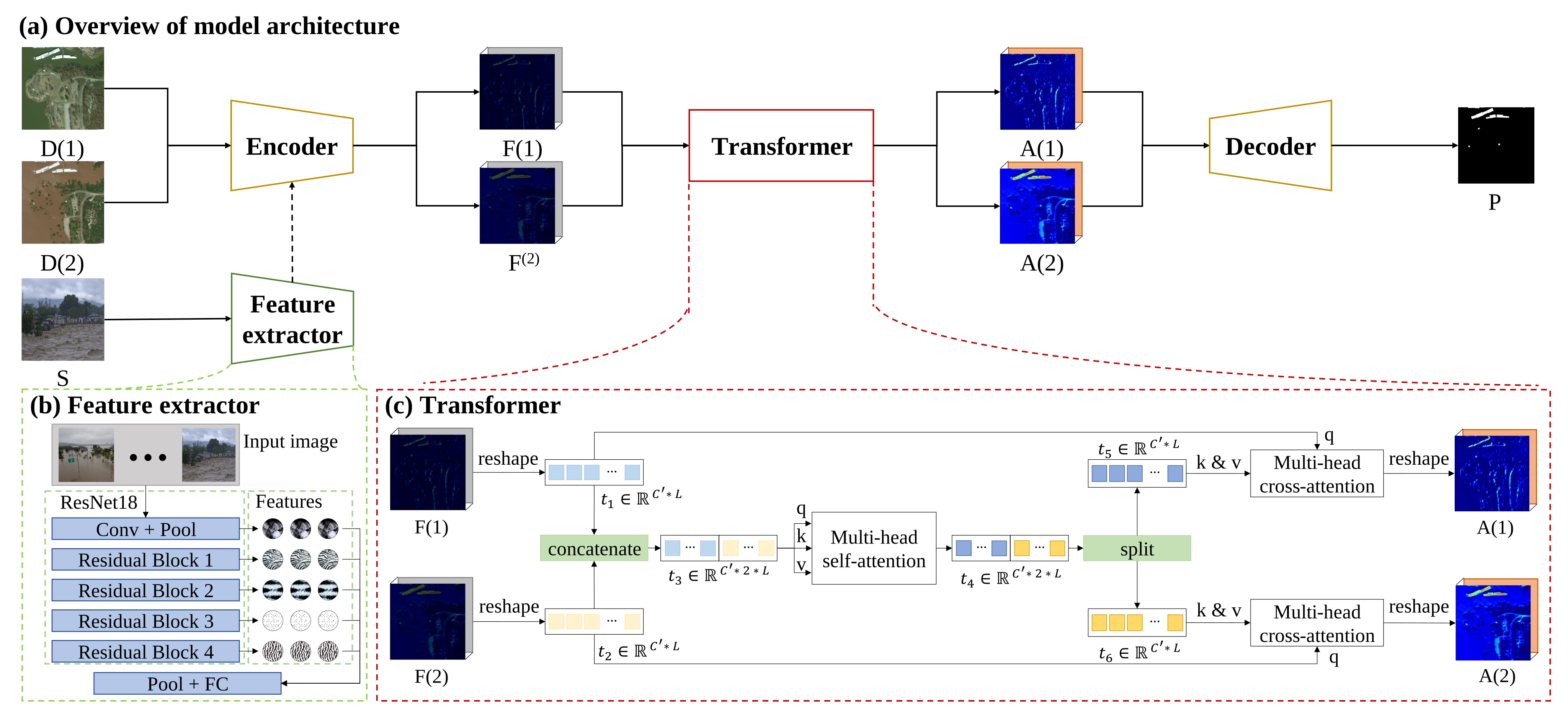
Developed a model that fuses bitemporal remote-sensing and
social-media images with an improved encoder.
Responsibilities
Independently completed study design, data processing, model
development, experiments, analysis, paper writing, and conference
presentation.
Achievements
Developed a bitemporal image transformer with CNN feature
fusion; achieved a 2% F1-score gain over baseline on the
Midwest-flooding dataset with 3.04M parameters.
Published and presented at CAADRIA 2024.
Click the image to open the full-resolution figure.
Build high-fidelity 3D digital assets for remote building and
facility inspection in mixed-reality environments.
Method
Reconstructed image sequences using Structure-from-Motion
toolchains (COLMAP and MicMac), and explored Neural Radiance
Fields (NeRF) for reconstruction and rendering.
Responsibilities
Contributed to the 3D reconstruction pipeline and compared SfM
and NeRF outputs.
Achievements
Generated high-fidelity 3D models for subsequent MR development
and compared reconstruction quality and efficiency across methods.
2020 — 2021Bachelor’s thesis
Commercial renovation of Zhongguancun Pedestrian Street
Advisor: Xianfeng Li
Objective
Develop a renovation strategy that reactivates Zhongguancun
Pedestrian Street.
Method
Conducted site analysis; used Rhino and Grasshopper for parametric
design exploration; and developed models and visualizations with
SketchUp, Revit, Lumion, and Adobe Creative Suite.
Responsibilities
Independently completed site analysis, developed the design
strategy, and produced final drawings, diagrams, and renderings.
Achievements
Delivered a complete renovation proposal and a professional design
portfolio.
2019 — 2020Undergraduate research
Historical evolution of public-art materials in Beijing
China Agricultural University · Advisor: Xianfeng Li
Objective
Investigate how material choices in public art in central Beijing
changed over time and relate to modernization, industrial capacity,
and economic development.
Method
Conducted fieldwork and built a SQL database of artwork dates,
materials, and artistic characteristics; applied correlation and
statistical-significance analysis in SPSS.
Responsibilities
Led field data collection, data organization, database development,
and data analysis.
Achievements
Produced a structured database and preliminary evidence linking
material use to industrial production capacity and economic
development.
Education
M.S. in Engineering
The University of Osaka, Japan
· Apr 2023 — Mar 2025
Staff, Landscape Project — Golden Valley government resettlement
housing
Shandong, China · Nov 2021 — Feb 2022
Supported project management for a 650,000 m² residential
development, overseeing earthwork operations and landscape planting
while coordinating with surveyors and subcontractors.
Staff, Decoration Project — Luoyang Olympic Center
Henan, China · Aug 2021 — Oct 2021
Participated in managing a 4.6B RMB, 45,000 m² project,
overseeing interior fit-out for a 60,000-seat stadium and model-room
construction, while supporting on-site measurements and workmanship.
Honors, awards & activities
Outstanding Staff, China Construction Eighth Engineering Bureau
Second Construction Co. (2021)
Third Class Academic Excellence Scholarship, China Agricultural
University (2019)
Academic Progress Scholarship, China Agricultural University (2019)
Member, The Magazine Landscape Architecture (China),
Stormwater Parametric Management Studio (2018)
Student Cadre, Sports Department, Student Union, China Agricultural
University (2017 — 2019)
Community-based research, China Agricultural University (2018)
Student support — Tutor for new international students, The
University of Osaka (2023 — 2024)